 By
By Nigeria needs more investments in innovation hubs and incubators to nurture startups from ideation to market readiness.
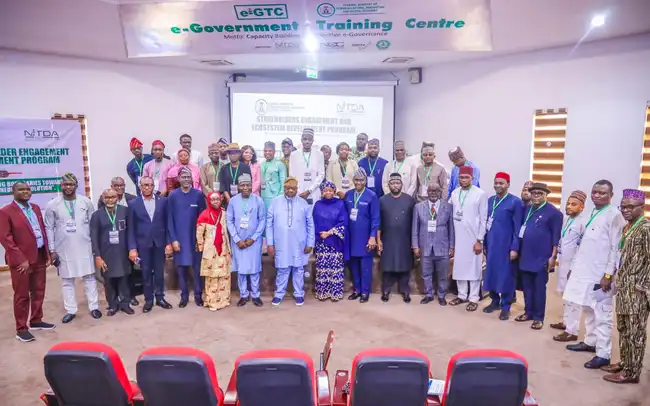
The Director General of the National Information Technology Development Agency (NITDA), Kashifu Inuwa who made the call NITDA-States IT Stakeholders’ Engagement and Ecosystem Development programme themed “Creating Opportunities, Breaking Boundaries: Towards Digitalization and Entrepreneurial Evolution”, stated that it will enable them to compete favourably on the global stage.
Inuwa who was represented by the Director of the Zonal Office, Mr Ajayi Babajide, said Nigeria’s economy Africa’s largest by Gross Domestic Product (GDP) is at a critical juncture that requires urgent diversification, noting that the digital economy presents a strategic pathway to sustainable growth, job creation, and inclusive development.
He explained that in today’s interconnected world, digitalisation has become a key driver of economic transformation, offering unprecedented access to knowledge and creating opportunities for developing nations to compete globally.
According to him, the technology sector remains one of the fastest growing and most impactful segments of the global economy, stressing the need for Nigeria to position itself to fully harness its potential.
Inuwa noted NITDA’s mandate to drive and coordinate digital innovation across the country, adding that the agency is focused on creating an enabling environment that empowers all sectors, including underserved communities, to contribute meaningfully to the economy.
He highlighted the implementation of the agency’s Strategic Roadmap and Action Plan (SRAP 2.0), designed to deliver life-transforming opportunities and strengthen Nigeria’s digital ecosystem.
He also pointed to the National Digital Literacy Framework (NDLF), which aims to equip citizens across various sectors with the digital skills required to thrive in a rapidly evolving economy.
The DG disclosed that NITDA has established over 100 IT centres nationwide and provided infrastructure to support digital learning and skills acquisition.
However, he emphasised that sustaining and expanding these initiatives would require deeper collaboration with stakeholders.
He called for stronger partnerships among government at all levels, the private sector, academia, and civil society, noting that innovation thrives in an ecosystem supported by effective policies, access to funding, and enabling regulations.
He observed that Nigeria’s innovation ecosystem has attracted significant investments and produced globally recognised startups, including unicorns, but said more efforts are needed to sustain the momentum.
Inuwa further noted that digitalisation holds immense potential for economic diversification, job creation, and inclusive growth, but warned that these opportunities must be deliberately harnessed through robust policies, legal frameworks, and strong institutional support.
He said the engagement provided a platform for stakeholders to exchange ideas, co-create solutions, and align strategies for the effective rollout of digital initiatives across states in line with SRAP 2.0.
The NITDA boss reiterated the agency’s commitment to fostering partnerships and providing the necessary support to drive Nigeria’s digital transformation, expressing confidence that collective efforts would deliver lasting impact.
He urged participants to remain committed to building a future where innovation thrives, opportunities are accessible, and Nigeria’s digital economy reaches its full potential.
In his earlier keynote address, the Permanent Secretary, Ministry of Innovation, Science and Technology Kogi State, Pharm. Eric Monday, explained that the state’s digital strategy is focused on applying technology to critical sectors, particularly healthcare, where efforts are underway to improve data management and expand service coverage. He added that similar interventions are being extended to works and environmental management.
He noted that outcomes from previous stakeholder engagements had helped shape actionable plans, stressing the importance of collaboration in achieving sustainable progress.
“Our goal is to learn from others while also sharing our experiences. The knowledge gained from engagements like this will help us strengthen our systems, create opportunities for our youth, and support skills development,” he said.
Highlighting ongoing projects, he disclosed that a skills acquisition centre, supported by development partners, is nearing completion and will soon be equipped to train young people in relevant digital skills.
Monday further revealed that the state is expanding its partnerships beyond Nigeria, including collaborations with Chinese organisations, to build a robust innovation ecosystem and open up new economic opportunities.
Describing Kogi as a “land of opportunity,” the official said the government is committed to leveraging its strategic position as the Confluence State to attract investment and promote growth.