 By
By
Telecommunications companies operating in Nigeria are still struggling with upfront taxation coming from all levels of Government structure.
According to stakeholders some states still charge as much as N10,000 per metre for Right of Way (RoW) as against the agreed N145.
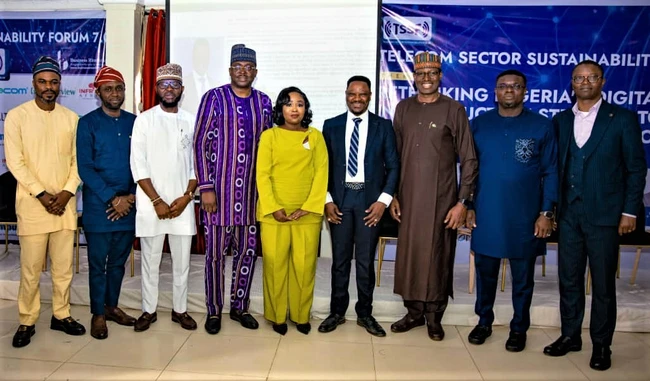
Speaking the 7th edition of the Telecom Sector Sustainability Forum (TSSF 7.0), the industry players noted the abysmal condition under which companies in the industry operate stating that the upfront taxation discourages investment.
However, the Chairman of the Association of Licensed Telecoms Operators of Nigeria (ALTON), Engr Gbenga Adebayo, said the Nigerian telecom industry has performed very well in its over 25 years of existence.
Adebayo urged stakeholders at the TSSF 7.0, which was organised by Business Remark, an online publication that stakeholders must tell the story of the industry despite the challenges warning that if operators fail to do so, critics will not speak for them.
Executive Secretary, Association of License Telecommunications Companies of Nigeria (ATCON), Mr Ajibola Olude, in his remark noted that the future of Nigeria’s digital economy depends not only on infrastructure but on opportunities created for people, businesses, and communities.
According to him, the industry needs industry-ready digital professionals, noting that most rural areas remain unconnected due to operators’ safety concerns.
He added that the sector’s contribution to economic growth cannot be overlooked, calling for platforms to productively engage youths saying that Nigeria’s high cost of capital, with interest rates exceeding 30 per cent, urging the banking sector to treat telecommunications as infrastructure of other infrastructure.
In a panel session, Chief Operating Officer, WTES Group, Mr. Chidi Ajuzie, noted that broadband penetration remains around 57 per cent despite mobile penetration of about 90 per cent noting that capital starvation, Right of Way crisis, and regulatory fragmentation remain as major obstacles to fibre rollout.
Ajuzie called for a transition from treating right of way as an immediate cash crop to a model recognising its long-term economic multiplier effect citing India’s BharatNet model, which laid 690,000 kilometres of rural fibre, as a working example for Nigeria.
On spectrum, he urged a shift from upfront fees to output-based models, arguing that the $800 million raised from 5G auctions could have been deployed into infrastructure.
According to him, open access fibre, digital public infrastructure, and local cloud could add 15 per cent to GDP by 2030, potentially contributing $300 billion to $400 billion to the digital economy.
Chief Executive Officer of Digital Realty Nigeria and Co-chair of the National Cloud Initiative Technical Working Group, Engr. Ike Nnamani, said in his presentation that Nigeria is currently losing an estimated $3.5 billion annually to foreign cloud service providers, as some government agencies have adopted cloud services over the past five years with their data hosted outside the country.
According to him, only about 30 percent of Nigeria’s approximately 1,000 government agencies currently use cloud services, with annual spending estimated at about $1 billion. If the remaining 70 percent migrated to cloud services within five years, annual government spending could rise to about $3.5 billion.
He disclosed that over 80 percent of Nigeria’s sovereign data is currently hosted outside the country, describing it as a significant national risk.
“This is the reality of the world we live in,” he said, citing the example of Iran attacking data centres in the Middle East during a recent conflict with the United States, demonstrating how digital infrastructure has become a frontline target in modern warfare.
On the National Cloud Initiative, Nnamani explained that it aims to make cloud services operational within Nigeria’s geographical boundaries, ensuring that data classified as critical, particularly financial data and information related to national security, is stored locally. He disclosed that opposition to the initiative has been fierce, with some individuals reportedly approaching the President directly to stop it.
Her remark, the Convener of TSSF, Mrs Bukola Olaranwaju said that the theme: “Rethinking Nigeria’s Digital Infrastructure Strategy to Attract Investment and Drive Innovation.” Aligns with the realities in the industry.
She noted that the forum was convened to move beyond rhetoric and proffer actionable solutions to Nigeria’s persistent digital infrastructure deficit.