 By
By The power by Africans to take charge of their opportunity to acquire learning or reskilling through digital access, particularly in the age of Artificial Intelligence may soon be their hands.
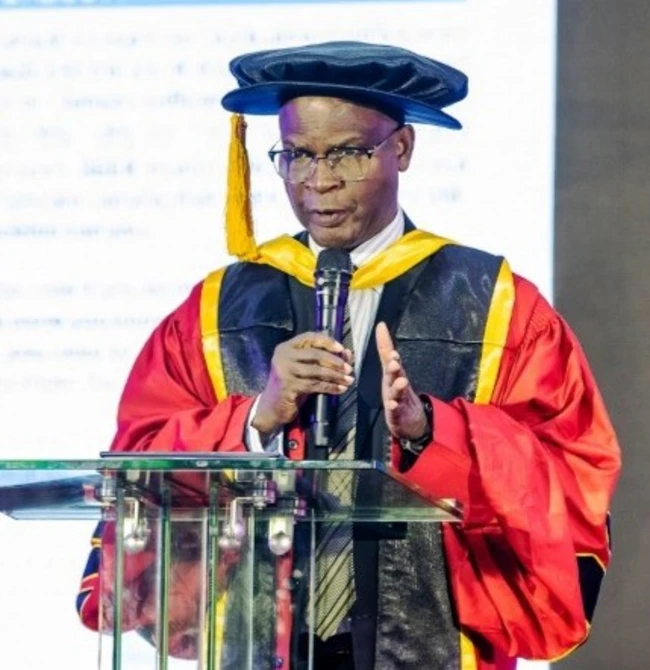
That is if the call by the President of the Accra Institute of Technology (AIT), Professor Clement K. Dzidonu, for a fundamental paradigm shift is accepted by critical stakeholders in that aspect of learming.
Dzidonu is concerned about how individuals, educational institutions, and society think about learning in the age of Artificial Intelligence (AI), arguing that graduation can no longer be regarded as the end of the learning journey.
He is advocating what he described as the Sovereign Lifelong Learner—the “Sovereign Triple-L” : an individual who takes ownership of continuing learning and assumes personal responsibility for continually renewing, deepening, and extending their capabilities throughout professional and personal life.
According to the AIT President, the traditional model in which people undergo intensive education, graduate, enter a profession, and rely for many years on much of the knowledge acquired during formal education is rapidly becoming unsustainable.
“You went to university. You acquired knowledge. You graduated. You entered a profession. And for many years, much of what you had learned remained relevant to what you were called upon to do. That world is disappearing,” he stated.
AI, rapidly advancing technologies, changing professional practices, and the continuing reinvention of industries, he argues, are transforming both the nature of work and the capabilities required to remain professionally relevant.
Dzidonu’s central proposition is that in the age of AI and rapid technological change, education and professional development must increasingly be understood as a continuing journey rather than something that ends with the award of a certificate or degree.
A university qualification remains important because it recognises what an individual has achieved at a particular point in time. It cannot, however, guarantee that the knowledge and capabilities acquired at that point will remain sufficient as technologies, professions, and societal needs continue to evolve.
Graduation should therefore not signal the end of learning, Professor Dzidonu argues, but the beginning of a new phase in which individuals increasingly take responsibility for directing their own continuing learning and capability development.
“The Sovereign Triple-L is not simply someone who keeps taking courses, accumulates certificates, or waits until an employer sends them for training. The Sovereign Triple-L is a Sovereign Lifelong Learner—a person who takes ownership of continuing learning,” he explained.
This requires individuals to continually ask themselves: What do I know? What can I do? What do I need to learn? What must I unlearn or relearn? Where are the gaps in my current capabilities? And what must I become capable of doing that I cannot do today?
The responsibility for answering these questions, he maintains, cannot rest entirely with universities, employers, or technology providers. Individuals must increasingly become sovereign over their own learning journeys.
Dzidonu describes an individual’s Skills, Expertise, Experience, Knowledge, and Know-how collectively as SEEK.
One of the defining challenges of the AI age, he noted, is the SEEK-Gap—the changing distance between the SEEK individuals currently possess and the Skills, Expertise, Experience, Knowledge, and Know-how increasingly required to remain capable, relevant, and effective.
This gives rise to what he describes as an important paradox: “The More You Know, the Less You Know.”
The AIT President, however, insisted that this proposition does not mean that learning reduces knowledge. Rather, the frontier of what professionals can know, can do, and are expected to be capable of doing is continually expanding.
AI is expanding that frontier. New technologies are expanding it further. New professional practices, tools, problems, and possibilities are continually extending it.
The challenge, therefore, is not simply to accumulate more knowledge, but to continually transform evolving SEEK into Professional-SEEK-Capabilities—the integrated capabilities required to perform, solve problems, exercise judgement, adapt, innovate, collaborate, create, lead, and make a difference.
For Dzidonu, lifelong learning is consequently becoming more than a desirable personal habit.
“The future will increasingly belong to those who remain capable of learning what tomorrow requires,” he stated.
Dzidonu stressed that AI should not simply be viewed as a technology that may render some existing knowledge or skills obsolete. Instead, it should prompt individuals to rethink what they learn, how they learn, and how they can use technology to extend their capabilities.
“The more useful question is not merely, ‘Will AI make what I learned obsolete?’ It is: ‘How will I use AI, technology, experience, reflection, and continuous learning to keep renewing what I know and what I am capable of doing?'” he said.
Becoming a Sovereign Triple-L therefore does not mean surrendering human judgement or learning to AI.
Rather, individuals should learn with AI, question it, challenge it, and use it responsibly, while continuing to strengthen their own capacity to think, create, exercise judgement, and learn.
The emerging challenge is not to fear what one does not yet know, Professor Dzidonu maintains, but to develop the capacity to learn what changing circumstances require.
At the heart of Professor Dzidonu’s Sovereign Triple-L proposition is the Opportunity–Possibility–Difference (OPD) Perspective, which provides a practical orientation for lifelong learning and continuing capability development.
SEE THE OPPORTUNITY means recognising that change, emerging technologies, unfamiliar assignments, mistakes, challenges, and even disruption can become opportunities for learning and growth.
EXPLORE THE POSSIBILITY means asking what new skills, expertise, experiences, knowledge, know-how, and capabilities can emerge from those opportunities.
CREATE THE DIFFERENCE represents the ultimate purpose of continuing learning: using what one learns and becomes capable of doing to create value, solve problems, improve lives, contribute to organisations and communities, and make a meaningful difference in the wider world.
Dzidonu’s message is therefore not simply a call for people to acquire more knowledge. It is a call to continually transform learning into capability and capability into meaningful difference.
Although articulated in the context of university graduation, he stresses that the Sovereign Triple-L mindset extends well beyond graduates. It is increasingly relevant to students, professionals, entrepreneurs, educators, business leaders, institutions, and others seeking to remain capable and relevant in a rapidly changing world.
What made an individual capable yesterday may not necessarily be sufficient tomorrow.
The response, Dzidonu stated, should be neither fear nor passive dependence on technology, but a continuing commitment to learning, capability development, and becoming.