 By
By The Borno State Government was in Lagos to lure the business community of the state to invest in the state as part of her 25 years development plan, which, Professor Babagana Zulum said would help to move the state from insurgency to recovery.
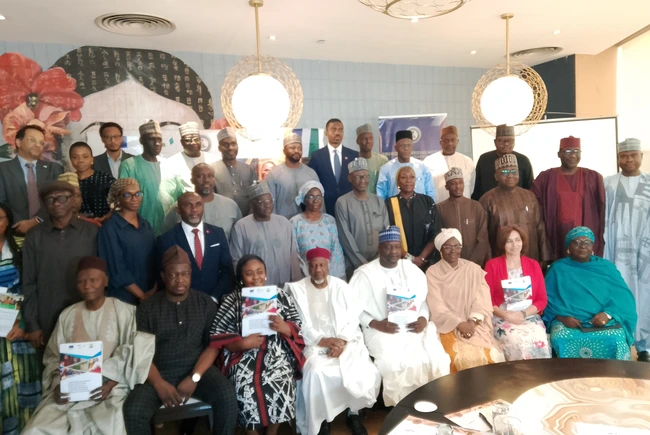
Zulum who spoke at the opening of a two-day Borno State Durable Solutions to Internal Displacement Private Sector Roundtable with the themed: “Mobilising Private Capital for Durable Solutions and Sustainable Development” called on the Nigeria’s business leaders and private institutions to invest in the state’s recovery from insurgency.
The Governor who was represented his deputy, Usman Kadafur, sort assistance from the private sector to help displaced families rebuild their livelihoods, and create jobs for young people.
Kadafur was in Lagos with a team that included the Commissioners for Reconstruction, Rehabilitation and Resettlement; Finance; Information and Internal Security; Works and Housing; Special Advisers; Permanent Secretaries; and the Executive Secretary, Borno State Investment Promotion Agency (BOSIPA), among other government officials.
He urged companies and private institutions to support resettled communities, partner with vocational institutions and invest in businesses that could sustain themselves noting the need for business commitments with clear timelines and measurable results.
The meeting hand in attendance senior government officials, corporate leaders, business executives, development partners, philanthropies, and other stakeholders in the sector.
“A camp cannot become a permanent address. And dependence cannot be the inheritance we pass from one generation to another,” Zulum said.
He appreciated the humanitarian organisations in the state including the Representative of the United Nations High Commission, Arjun Jain, Head of Programme, Giz Sepin Susiu, Ana Vin Ambres, Chief of Missions, IOM, Sharon Dimanche and Head of UNDP, Lagos Sub-Office, Williams Tsuma for saving lives during the crisis, saying lasting recovery would require families to earn a living, obtain essential services and regain their independence.
According to Kadafur the Borno’s 25-year Development framework aims to develop the state into a secure, competitive agribusiness and commercial hub through investment in people, agriculture, health, environmental sustainability and regional trade.
“We have learned that closing a camp is not the same thing as ending displacement,” he added.
He stressed that moving a family out of a camp did not, on its own, resolve displacement saying that in Monguno, the state government, the United Nations Development Programme, the Federal Government, Germany and other partners supported the provision of 1,900 permanent homes and semi-permanent shelters, alongside 375 solar streetlights.
He also added that about 4,000 people received grants, technical and vocational training, start-up packages and agricultural inputs saying that women made up 40 per cent of the beneficiaries. The programme also covered water, energy, markets, essential services, safety and social cohesion.
“Housing alone is not resettlement. Housing plus livelihoods, education, healthcare, security, infrastructure and economic opportunity is what turns a settlement into a community,” he said.
On education, the Governor said the administration had built 104 new schools and rehabilitated 2,931 classrooms and related facilities by December 2025. School enrolment had also risen above 1.8 million children, while the estimated number of out-of-school children had fallen below 800,000.
He said about 3,000 young people also graduated from nine vocational enterprise institutes and centres across the state earlier in 2026. They received tools, starter packs and entrepreneurship support to help them put their training to use.
“I am therefore not asking you to choose between conscience and commerce. I am asking you to recognise that, in Borno, conscience and commerce can reinforce one another,” he said.
The Governor asked companies to direct their corporate social responsibility spending towards projects that would help communities become self-sufficient. These could include schools, vocational centres, primary healthcare facilities, water systems and support for women and youth entrepreneurs.
“I therefore propose that this roundtable must not end with photographs and communiqués.”
The Governor urged business leaders to help displaced families become homeowners, farmers, employees and entrepreneurs, while opening up employment and business opportunities for young people vulnerable to violent recruitment.
Also speaking Chief of Staff to the Governor, Dr Babagana Malumbe, noted that the Governor has put in place measures to prevent double taxation for companies operating in the state.
He explained that the revenue collection process in the state has been well harmonised to prevent companies from paying twice for the services in whatever ways.
Chief Adviser to the Governor on Sustainable Development, Partnership and Humanitarian Support, Dr Mairo Mandara, under whose office the meeting with the private sector in Lagos was expressed Zulum’s administration’s readiness to provide a strong partnership and a level playing field for sustainable investment.
“Government can construct schools, clean schools while development partners can finance stabilisation and provide concessional capital. Humanitarian organisations can protect people during economic crisis’, she said.
According to her, business people, business organisations, have something uniquely important to bring that no government, not government, not humanitarian, and nobody, and that is the ability to create jobs, supply chains, customers, and market at scale.