 By
By Experts in the health tech space are excited that more trends are now evolving where technology is now a key factor in delivery health care service in all areas such as Digital health, MedHealth, ITmHealth and eHeath.
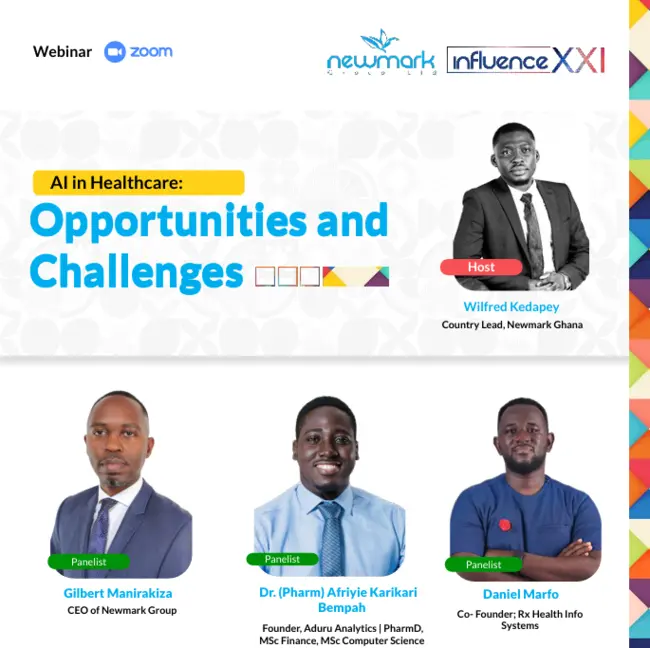
Speaking at a webinar with the theme: ‘AI in Healtrhcare: Opportunities and Challenges’ organised by global communication company, Newmark during its Influence XXI series, the speakers disclosed that health insurance companies have adopted AI at the core of how they work, and it is really beginning to bear a lot of fruits.
In his opening remarks, Chief Executive Officer, Newmark Group, Gilbert Manirakiza said said that “we are now really coming fully embedded with AI systems to assist the healthcare to be able to do triaging faster and better, and to also help point relations they may have missed.”
He added: “Today we see a lot of EMRs where as the doctor types their notes, they can see the assistant button there. If they click, it can probably tell them based on three, four conditions. If there is some kind of particular symptom they are not really sure of, the AI assistant can help give them certain options.”
Speaking further, he said that the healthcare sector has been quite important for the Newmark Group, adding that 91% of PR and communications professionals globally are now using generative AI as a part of their daily workflow.
Manirakiza observed that “they use this every single day, and in no other sector is that shift more consequential and remarkable than in healthcare. And here is why I say that this is remarkable. It’s because healthcare is not a single communications environment. It has many microcosms of communication.”.
According to Country Lead for Newmark Ghana, Mr Wilfred kedapay, to optimize the use of AI for speed and scalability, “we must put in a very robust process to ensure that the full essence of AI use in healthcare is achieved,.”
He said, “during the COVID-19, our health resilience was tested where we were found wanting, especially many African countries, had their health system tested. My question to you is that now with the inclusion of AI in healthcare, how is AI enhancing the resilience of health systems to better withstand shocks like pandemic as we witnessed in COVID-19 and adapt to that change to the healthcare demands we currently have.”
Also speaking at the webinar, and while responding to questions, Co-founder, Rx Ibnfor System, Dr Danie; Marfo said that if there is some kind of particular symptom doctors are not really sure of, the AI assistant can help give them certain options adding that it doesn’t mean that the AI is replacing the medical doctor.
“Being able to decipher and go through tons of information, excuse me, in a limited time with the client or the patient in front of them. And for us, seeing that has been very, very transformative”, he said.
He stated: “The way AI is able to analyze your x-ray, your lab results, your images. It is just transformational to be able to study an x-ray or an MRI or a CT scan. The AI today is able to help you identify all those things. And it is very instrumental because today there are very limited number of x-ray results. So sometimes you could even do the scan and they will tell you that the radiologist is not around.”
He further revealed that at the at the macro level, where policy makers, decision makers, decisions are being made, culminating in the health systems of countries coming through, they the policy markers are using systems ranging from cloud AI for their own custom-built AI systems.
“So if you check Rwanda, Sierra Leone, they are all building national health intelligence agencies and centers where it is fully AI-embedded. Viewing all the health data, meaning that your policy makers are able to make better, smarter, faster decisions. So I would say these are some of the few ways we are seeing AI really transforming healthcare”, he said.