 By
By Women professionals across the tech space in Nigeria have outlined critical issues that border on not just bridging the digital divide but giving the women folks leeway in the technology sector.
The women who spoke at a webinar with the theme: Future Female-Safe & Inclusive Tech in a High-Speed Digital World organised by DigiVation Media to mark the 2026 International Women’s Day noted the need to unlock opportunities for women so that Nigeria will gain in innovation.
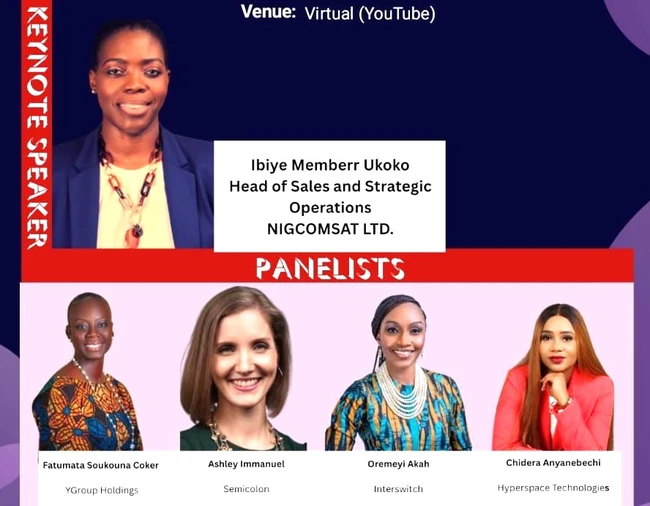
The Head of Sales and Strategic Operations, Nigerian Communications Satellite, NICOMSAT Limited( NigComSat), Ibiye Ukoko stated that
digital transformation begins with access for women saying that millions of Nigerians, especially in underserved communities, are still excluded from the digital economy.
She said: “Only about 4.5% of the National Assembly in Nigeria are women. So in the country where women make up about 50% of the population, we have less than 5% occupying the legislative seats”, stressing that “Access is not just about connectivity, it’s about giving opportunity. So we must expand broadband and satellite connectivity. We must reduce the cost of this access.”
Ukoko said further: “We must prioritize schools, SMEs, and rural communities. And we must embed digital literacy along infrastructure. This is important because when you give access, you give people the ability to participate in this ecosystem.”
While harping on the impact of AI across sector, she said that “AI is shaping our future, but the simple truth is that we must reflect our current realities, and so tailor Nigeria into the reality of the world.”
She explained that “If the systems are built without diverse voices, they will only serve a fraction of the society. So, for example, if we’re looking at a typical home, if a man designs a home versus a woman designing a home, there are differences in terms of things that, you know, the woman will ensure is built in the design.”
According to her, there are things that man will ensure is built in the design but the woman will make sure that the kitchen has enough space, for example.
While calling for investment in local data and talent, she said: “We must support indigenous innovation. We need to ensure that women are not just users, but creators and leaders, which is why I gave the example of just a typical house. So we need to build trust.”
Warning recent trends in cybersecurity, Ukoko said that a digital economy without trust cannot thrive saying that “we must build a cybersecurity awareness, develop local expertise, and integrate security into every solution. Because when we give security, we give confidence to innovate and grow.”
She harped on the need to close this gap noting, “We’ve identified the gap with the numbers and the percentages. So this is not about just a women’s issue.
“It’s an economic imperative. When women are excluded, innovation is limited. Growth is slow, and opportunities are lost.
“But when women gain, economies multiply. So to create the future, Nigeria as a country must move from being a consumer of technology to be a creator of solutions. So, we must support startups and local innovation.
“We must strengthen policy and investment frameworks. We must foster partnerships across sectors. Because again, when we give platforms and support, we enable others to build.”
Speaking on safety for women during a panel session, General Manager, Hyperspace, said “we can’t talk about safety without the government because the government are the huge regulators.”
According to her, the Nigerian Government have the power to curb menace online insecurity for women adding, “we’re in the era where you can literally generate anything, AI generated contents, and I think those are the risks and concerns around women’s safety and women data privacy.
“So I think the government has a huge role to play in terms of making sure there are adequate laws and regulations around such issues.”
Speaking further, she said women should also beef themselves with the right knowledge to know how to interact with online saying, you have to understand how to use your data online on social media, where to, what websites to click, which websites to go to, what apps to check, what passwords, you know, your passwords, putting your passwords on vague websites.”
Also speaking during the panel session, Fatumata Coker harped on the need for women to understand the digital age so that they can also protect their children while also protecting themselves.
According to her, we need to understand that when they’re engaging with technology, they’re engaging with it with knowledge and information, adding children are basically in the world of digital without parenting.
She said: “We need to help our parents that may not be technology savvy to understand what is in the hands of their child. This thing that we call smartphone, it’s fun to say, oh, I have a birthday present for my seven or eight-year-old and I’m giving them a phone.”
Coker added: “It’s a nice gesture. But what does that mean for that child? What are you exposing them to? And what do you know about this device that you’re handing them? Back in the day, we got bikes. We got doll babies and play guns and BB guns.
“Our parents knew about those things and they could easily guide us around that. Today, we don’t have that.”