By
By Several human development projects designed by the presidency, the National Information Technology Development Agency (NITDA), the National Assembly (NASS) to improve the life of Nigerians were during the week unveiled by Nigeria’s First Lady, Mrs Oluremi Tinubu in Hadejia, Jigawa State.
The projects: the President Bola Ahmed Tinubu Academy, alongside a modern clinic and dialysis centre named in honour of the President’s wife, were described by Mrs Tinubu as “clear evidence of the government’s commitment to improving infrastructure, expanding access to quality healthcare, and investing in the future of the young.”
According to her, the state-of-the-art clinic would bring relief and hope to many patients and their families in Hadejia, neighbouring communities, and beyond.
She added that the academy represents President Tinubu’s dedication to human capital development and educational excellence, which secures “a better tomorrow” for Nigeria’s children.
In addition to the health and education projects, Tinubu also launched the National Food Bank Programme, a deliberate and sustainable response to food insecurity and malnutrition among vulnerable households.
The initiative is designed to ensure that children under six, pregnant women, and lactating mothers have access to nutritious food, directly advancing President Tinubu’s Renewed Hope Agenda on food security and improved health outcomes.
The programme is being implemented through a strategic partnership between the Office of the First Lady, the Federal Ministry of Health and Social Welfare, the National Primary Health Care Development Agency, and the Bank of Agriculture.
According to her, the initiative will build a stronger and more prosperous Nigeria by safeguarding the health and future of its most vulnerable citizens.
The clinic and dialysis centre were built and fully equipped by FutureMap Foundation and eHealth Africa, in honour of the First Lady’s passion for uplifting underserved communities and vulnerable people.
The President Bola Ahmed Tinubu Academy was established with the support of the President and the National Information Technology Development Agency (NITDA), underscoring the administration’s commitment to innovation and education.
Both projects are designed to work hand in hand. The academy, with its fabrication laboratory and advanced learning facilities, will support the clinic by developing prototypes of body organs — especially kidneys — to aid research, early detection, and prevention of chronic kidney disease. This synergy ensures that education directly fuels healthcare innovation, creating practical solutions to pressing medical challenges.
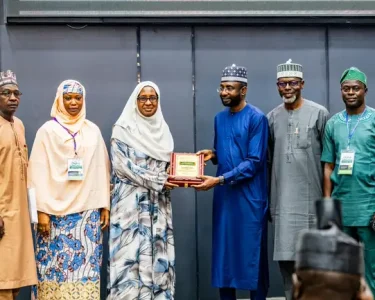
The First Lady, who expressed deep appreciation to the NITDA Director-General for the honour, re-emphasised the benefits of the academy and the clinic saying: “We are grateful for these honours done to us. Thank you.
These projects are clear evidence of the state and federal government’s commitment to improving infrastructure, expanding access to quality healthcare, and investing in education and the future of young people.”
The First Lady further highlighted that the Bola Ahmed Tinubu Academy represents the President’s commitment to human capital development and educational excellence.
She added, “By investing in the education of our children today, we are securing a better tomorrow for them.”
While speaking on the National Food Bank Programme, the First Lady described it as “a deliberate and sustainable response to food insecurity and malnutrition among vulnerable households in Nigeria.”
She stressed that the initiative is designed to ensure that children under the age of six, pregnant women, and lactating mothers have access to nutritious food, adding that “this programme aligns with the Renewed Hope Agenda of His Excellency President Bola Ahmed Tinubu, advancing food security, improving healthcare outcomes, and building a stronger and more prosperous Nigeria.”
She explained that the programme is being implemented through a strategic partnership between the Office of the First Lady, the Federal Ministry of Health and Social Welfare, the National Primary Health Care Development Agency, and the Bank of Agriculture.
Commending the swift implementation in Borno, she observed that the programme has already enrolled 560 beneficiaries and reached 468 vulnerable children, pregnant women, and lactating mothers in less than two months. “This impressive achievement gives me confidence that Jigawa State will set even higher standards for others to follow,” she declared.
The First Lady emphasised that Jigawa’s agrarian potential makes it a strategic choice for the North-West launch and called for “sustained collaboration to build a transparent, accountable, and efficient food bank system that reaches vulnerable households across Nigeria.”
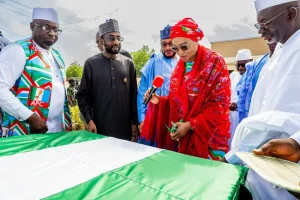
Earlier in his remarks, the Jigawa State Governor, Mr Umar Namadi, expressed deep appreciation to Mrs Oluremi Tinubu and all distinguished guests, noting that their presence in the state for the North-West launch of the National Community Food Bank Programme was “a strong demonstration of solidarity with families who need support and a reaffirmation of our shared duty to protect the vulnerable segment of our population.”
The newly commissioned projects in Hadejia, especially the President Bola Ahmed Academy and the Senator Oluremi Tinubu Clinic represent a deliberate effort to integrate advanced technological innovation with critical healthcare delivery.
The Academy is structured as a sustainability-oriented institution, designed to transform technical knowledge into practical community solutions.
Its infrastructure includes a fabrication laboratory and maker space for prototyping health wearables and prosthetics, an innovation lab with AI-driven tutoring, and a pitch space for start-ups and research ideas. Complementary spaces such as the atrium, auditorium, and residential hostel ensure that the academy functions not only as a training ground but also as a hub for collaboration, digital upskilling, and community engagement.
Together, the academy and clinic form a symbiotic model in which education and healthcare reinforce each other. The academy’s fabrication laboratory is expected to provide diagnostic tools and organ prototypes, while the clinic applies these innovations in real-world patient care.
This collaboration offers a pathway for early detection and prevention of chronic illnesses, particularly kidney disease, while also strengthening Nigeria’s broader health technology ecosystem.
The integration of infrastructure, innovation, and medical service delivery positions Hadejia as a potential model for how technology and healthcare can be combined to address pressing community needs.
It may be recalled that last week, the President launched the establishment of the National Health Technology and Data Analytics Office, a move expected to strengthen Nigeria’s capacity for medical research, data-driven healthcare delivery, and the integration of technology into public health systems.